Mercury to Neptune: First Aid Skills Your Top 8 Friends Should Know
Your Snapchat solar system shows who you talk to most. It doesn’t show who would know what to do if one of them collapsed at practice, at a concert or on a summer job. If you’re in Saskatoon, First Aid and CPR Training is a way to turn that closeness into something that could save a life.
Snapchat’s Friend Solar System ranks your top eight friends as planets, from Mercury to Neptune. Here’s a first aid solar system to go with it.
Why Should Your Closest Friends Know First Aid?
Because they’re the people around you when things happen.
Think about where you spend time with your top eight. Practices and games. Road trips. Shifts at work. Parties, concerts, long nights studying. If something goes wrong, the person nearest to it is usually a friend, not a paramedic.
And paramedics need time to get there. Heart & Stroke notes that emergency response times can be six minutes or more in urban centres, and longer in remote communities. Those minutes belong to whoever is in the room.
What Do the Numbers Say?
They’re bigger than most people think.
According to Heart & Stroke, about 60,000 cardiac arrests happen outside hospitals in Canada every year. That’s roughly one every nine minutes. Only one in 10 people survives. Nearly half of them happen to people under 65, so this isn’t only about older adults.
Here’s the hopeful part. Heart & Stroke says doing CPR and using an AED can double a person’s chance of survival. Every minute without them lowers the odds by about 10%. Acting fast matters more than being perfect.
What Is Your First Aid Solar System?
Here’s a fun way to remember the skills. Planet by planet, this is the order I’d suggest learning them. The order is my own suggestion, so use it as a memory trick.
Mercury: Call for help. Dial 9-1-1, say what’s happening and give your exact location. Stay on the line until the call taker says you can hang up. Don’t film. Call.
Venus: Start CPR. If someone collapses and isn’t breathing normally, start CPR right away. Heart & Stroke’s three steps are simple: call 9-1-1 and shout for an AED, start CPR, and use an AED as soon as one is available.
Earth: Use an AED. An AED is a portable device that can shock the heart to help it restart. A course lets you practise with a trainer unit, so it doesn’t feel strange on the day.
Mars: Handle choking. When someone can’t cough, speak or breathe, fast action matters. A course shows you how to help, and how to adjust for children and babies.
Jupiter: Control bleeding. Pressure, dressings and knowing when to call for help. Big problems need big skills, and this one is easy to practise.
Saturn: Spot an allergic reaction. Swelling, hives and trouble breathing after food, a sting or a medicine are all warning signs. Call 9-1-1, and help the person use their own auto-injector if they have one.
Uranus: Recognize a heart attack. A heart attack looks different from a cardiac arrest. The person is usually awake, with chest or upper-body discomfort, sweating, nausea or shortness of breath. Call 9-1-1, and have them stop and rest.
Neptune: Stay calm. The most distant planet is the hardest skill. Take a breath, give clear instructions and keep other people calm. Practice helps more than anything.
None of these replaces a hands-on course. They’re a map of what to learn first.
How Do You Know It’s a Cardiac Arrest?
Heart & Stroke lists four signs: a sudden collapse, loss of consciousness, no response to touch or sound, and not breathing or not breathing normally.
If you see them, don’t wait to be sure. Call 9-1-1, shout for an AED and start CPR. Heart & Stroke stresses that you can’t hurt someone by trying, you can only help.
How Do You Pick a Course?
Look for these things:
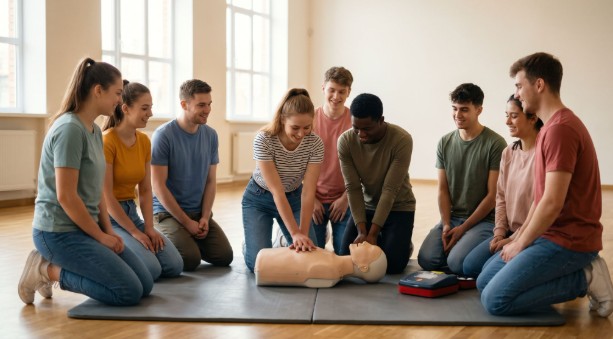
- Hands-on practice. You want time on a mannequin and an AED trainer, plus an instructor who gives feedback.
- A format that fits your schedule. Many courses are blended: you finish the theory online, then attend a shorter in-person session for skills. That works around school, work and sports.
- The right level. Ask which course suits your goals, from CPR/AED to full first aid.
- Certificate details. Ask how long the certificate is valid and how renewals work. Coast2Coast’s Saskatoon page lists a three-year certificate for its first aid and CPR/AED Level C courses.
- An age-appropriate option. If you’re between 11 and 15, the Saskatoon page lists a Red Cross Babysitting course that teaches basic first aid and child care. Younger kids can take Stay Safe!
Not sure where to start? Check the Coast2Coast First Aid course list to compare formats.
What’s Happening in Saskatoon?
Coast2Coast’s Saskatoon classes are still being scheduled. The Saskatoon page has a waitlist open, and venue details will be shared when classes open. If you want updates, join the waitlist on the page.
Meanwhile, you can start learning the basics at home.
How Can You Get Your Friends Involved?
This is where the top eight comes in.
Take the course together. A friend group learns faster, and everyone remembers the steps better when they’ve practised together.
Ask about group training. Coast2Coast lists private group training for teams of eight or more. That’s exactly a top eight. Sports teams, clubs, study groups and work crews can all ask about it.
Make a plan. Decide who calls 9-1-1, who fetches the AED and who starts CPR. Say it out loud once, and it’s much easier to do for real.
What Can You Do While You Wait for a Class?
You don’t have to wait to start:
- Learn the three steps. Call 9-1-1 and shout for an AED, start CPR, use an AED.
- Know your address. Be able to say where you are, including a street or landmark.
- Set up your phone. Fill in your medical ID and emergency contacts, and learn your phone’s emergency gesture.
- Find the AED. Notice where one is at your school, gym or workplace.
- Talk about it. Ask your friends if they know what they’d do.
Why Does It Matter?
Because the people on your solar system matter. Rankings change. Friendships grow and drift. But the skills stay with you.
If you are looking for first aid training near 8th Street and Broadway Avenue, the University of Saskatchewan area, or surrounding areas in Saskatoon, you may reach out to Coast2Coast First Aid & Aquatics in that area.
FAQs
Q: Do I need to be sure someone is in cardiac arrest before I act?
A: No. Heart & Stroke lists the signs as sudden collapse, loss of consciousness, no response to touch or sound, and not breathing or not breathing normally. If you see them, call 9-1-1 and start CPR. You can’t hurt someone by trying, you can only help.
Q: What are the three steps for a cardiac arrest?
A: Call 9-1-1 and shout for an AED, start CPR right away, and use an AED as soon as one is available. Don’t wait for paramedics to arrive.
Q: How long is a CPR/AED Level C certificate valid?
A: Coast2Coast’s Saskatoon page lists a three-year certificate for its First Aid and CPR/AED Level C courses. Always confirm the details for the course you choose.
Q: Is there a first aid course for teens and kids?
A: The Saskatoon page lists a Red Cross Babysitting course for ages 11 to 15 that includes basic first aid, and a Stay Safe! program for younger children. Check the page for current availability.
Q: Are Coast2Coast classes running in Saskatoon yet?
A: The Saskatoon page currently has a waitlist open and says venue details will be shared when classes open. Check the page for updates.